More turnover, same profit: where the difference goes
When sales grow but profit stands still, the gap rarely goes on stock. More often it goes on manual handling around every order. Here's how to check.
4 min read
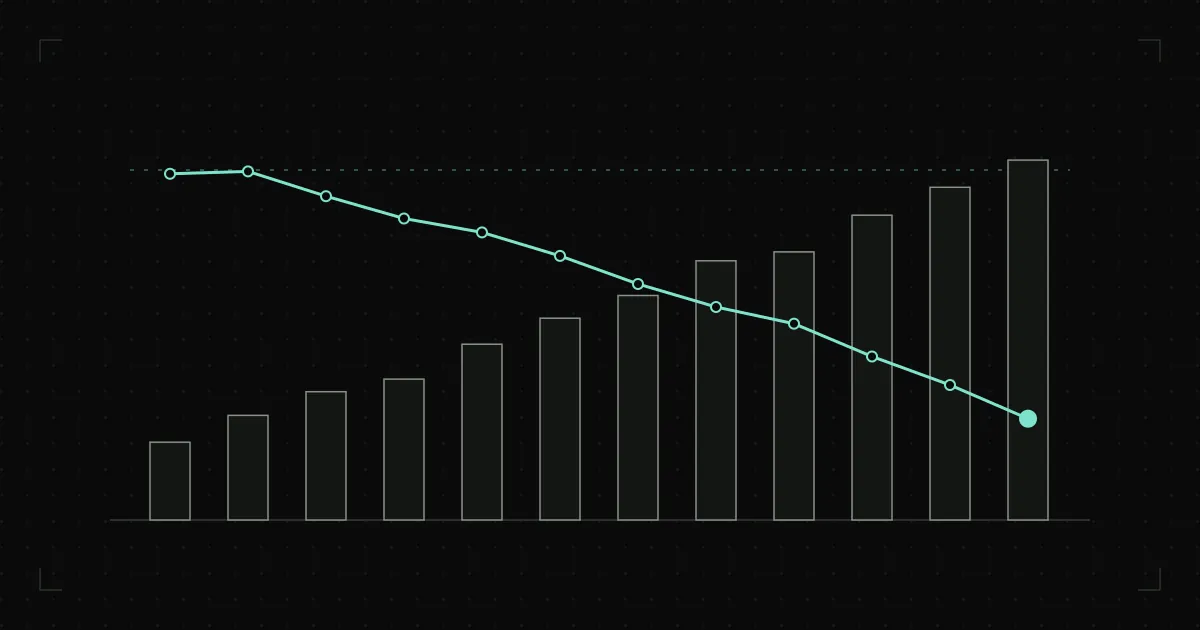
It was a good year. More orders than last year, regular customers coming back, new ones arriving by word of mouth. Then the accountant sends the figures, and the bottom line has not grown anywhere near as much as sales did. Sometimes it has not grown at all.
The usual suspects are purchase prices or a competitor undercutting you. Sometimes that is exactly it. But very often the difference goes somewhere nobody books as a cost: the manual work people do around every single sale.
Every order carries a handling cost
The purchase price of an item sits in your costing. What sits nowhere is how many people, and how many minutes, it takes for that order to travel from the first phone call to a paid invoice.
Someone takes the order by phone or email. Someone keys it into the system. Someone walks to the shelf to check the goods are really there, because nobody quite trusts the stock figure. Someone rings the customer back. Someone packs, someone raises the delivery note, someone the invoice. Someone later chases the payment.
While volumes are low, nobody notices this work. The same people fit it in around everything else. When orders double, nobody types twice as fast. The work stretches, things start running late, and mistakes pile up exactly where people are most tired.
Where profit thins out without anyone writing it down
- Keying errors. A wrong code or quantity means a return, a second delivery and transport you cannot charge for.
- The goodwill discount. When something is late or wrong, a salesperson knocks a bit off to keep the customer. The discount shows on the invoice; the reason shows nowhere.
- Invoices waiting for paperwork. If invoices only go out once the week’s delivery notes have been gathered, money for goods already delivered stays with the customer for longer. If you sell on credit terms, you are effectively lending that money for free.
- Cancellations and credit notes. Every corrected document is someone’s hour — yours and your accountant’s.
- Stock that only exists on screen. You sell what the system says you have, and you don’t. Then come the apologies, the substitute or the cancelled order.
- Your best people on your worst work. An experienced salesperson spends half the day retyping instead of selling.
None of these on its own ruins a year. Together, multiplied by higher volumes, they eat precisely the margin you expected to see.
Why “after the busy season” never quite arrives
During the season there is no time to change anything; the team barely keeps up with deliveries. Outside the season there is no pressure, because things run tolerably. So the change slips from one year to the next.
Meanwhile, the cost does not stand still. Manual handling scales with the number of orders, so each month of higher turnover costs more than the one before. Deciding to wait is still a decision. Its price just never arrives as a quote you can turn down.
There is a practical reason not to wait, too: the worst moment to introduce a new way of working is the peak of the season. If you know when your rush comes, preparation should start a few months earlier, while people still have time to learn.
Work it out on your own orders
You do not need a consultant for the first figure. You need an afternoon and an honest conversation with the people who do the work.
- Pick one ordinary order from last week. Not the worst, not the best.
- Write down every time someone touched it: took it, entered it, checked it, phoned about it, corrected it, invoiced it, chased the payment. Ask people; don’t assume.
- Next to each step, note roughly how long it takes. An estimate in minutes is fine.
- Add up the minutes and multiply by your monthly number of orders.
- Separately, count how many orders a month need some kind of correction, and what each correction sets off.
The result will not be accurate to the minute, and it does not need to be. What matters is the order of magnitude and which steps create it. Often, two or three steps account for most of the time — and they are exactly the steps where the same detail is retyped from one place into another.
Where to start
Not with everything at once. With the point that hurts most.
For businesses that sell goods, it is usually one of three things. An order entered once, with the delivery note and invoice generated from it. A stock figure a salesperson can rely on while the customer is still on the line. Or invoicing at the moment of delivery rather than at the end of the week.
Sometimes the answer is simply to configure the software you already own properly, which is the cheapest outcome. Sometimes a new part of the system is needed. Before anything is bought or built, it is worth knowing which of the two you are facing, and in what order to proceed.
If you would like to go through this calculation with your own figures and come away with a written sequence of steps, that is the work described on our IT consulting and digitalisation plan page. And if you already know where it hurts, drop us a line with a few sentences about it.