Before the AI assistant: write down who decides what
AI reads, sorts and drafts well, but can't know whose decision something is. Without written rules and a route for doubtful cases, its work goes nowhere.
4 min read
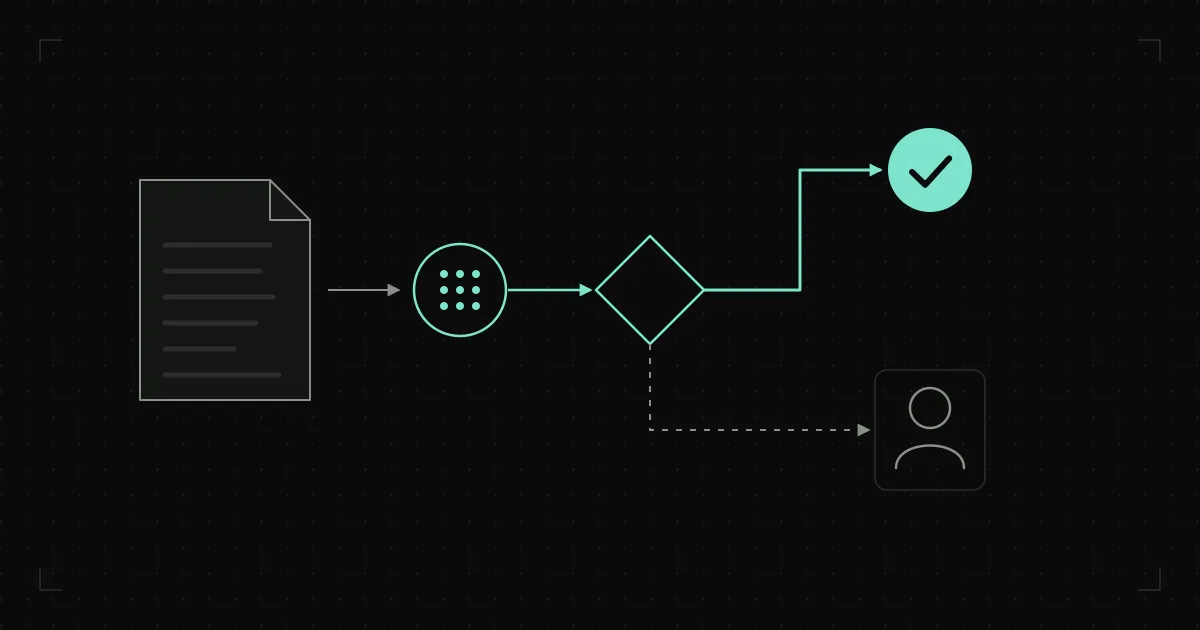
The trial went brilliantly. The AI reads emails arriving at the shared inbox, recognises orders, enquiries and complaints, and pulls out what matters from each message. In the demo it looked impressive. A month after go-live, the system holds a pile of neatly sorted messages that nobody has opened.
The model did its part. Nobody decided what happens to its work next.
What AI does well, and what it doesn’t
AI is good at work where the input is untidy. It reads free-text emails, scanned documents and photos. It sorts. It extracts data. It summarises. It drafts a reply or a proposed accounting entry.
What it cannot do is know what isn’t written down anywhere. It doesn’t know that one customer always gets credit terms, if that only exists in a sales rep’s head. It doesn’t know who in the business resolves a price discrepancy. It doesn’t take responsibility for a decision.
When a rule is written down, AI follows it well. When there is no rule, AI makes one up — with complete confidence.
Four things that must be written down
What comes in
What kinds of input arrive, in what form and from where. For example: invoices come as PDFs by email, delivery notes as photos from an app, and the occasional one still by post on paper. Each of those routes needs its own place.
Who decides, and by which rule
For each kind of output, it must be clear who picks it up and which rule they follow. “An order from an existing customer within their limit goes straight to processing. An order from a new customer goes to the sales rep.” The rule can be simple, but it has to exist somewhere other than in someone’s head.
What happens when the system isn’t sure
There has to be a threshold below which the system doesn’t decide on its own, and a named person those cases go to, with a deadline. Not “someone will have a look”, but exactly who, and by when.
Where the outcome is recorded
Whatever the person decided in a doubtful case gets recorded. For two reasons: to measure over time how accurate the system is, and to see where rules are missing, because the same doubtful cases keep recurring.
An example: supplier invoices
- Input: a supplier invoice arrives as a PDF by email.
- Reading: the AI extracts the supplier, lines, amounts and payment terms.
- Rule: the invoice is compared with the purchase order and the goods receipt. If everything matches, a proposed entry is created.
- Decision: a small price difference within the agreed tolerance goes to accounts. A larger one goes to purchasing to check with the supplier.
- Uncertain: an illegible scan, or a supplier not on file, goes to a named person with a same-day deadline.
- Outcome: every human correction is recorded against the invoice.
In practice, the “decision” step is where things most often get stuck. Everyone knows price differences happen, but nobody has written down who deals with them. So the AI dutifully flags the problem, and the flagged problem ends up in a queue that belongs to nobody.
An assistant that answers staff questions
The same principle applies to an assistant that answers questions from internal documents. There has to be a decision about which documents are the source of truth and who keeps them up to date.
If the price list exists in five versions scattered across emails, the assistant will answer from one of them — not necessarily the current one. So every source needs one location, one owner and a date from which it applies. And alongside each answer, the assistant should show which document it came from, so a person can check.
How to tell whether you’re ready
- For each kind of input, can you say who handles it today?
- Is there a rule written down anywhere other than in someone’s head?
- Would a new employee know from what is written what to do with a doubtful case?
- Do you know how long the work takes today and how often it goes wrong, so you have something to compare against?
If the answer is mostly “no”, the first step isn’t a model. It is a few working sessions where those decisions get written down. That takes days, not months, and it is worth doing even if AI never arrives.
Before we propose any model, we write these decisions down with you and measure accuracy on your own data. There is more about it on our AI automation page. If you already have an AI pilot nobody uses, get in touch — often all it lacks is a rule for what happens next.